
What Is Horsepower? The Horse Behind Every Engine You Drive
Every car ad brags about it. Every dyno shop sells more of it. Yet most drivers cannot explain it. I have answered this question at countless shop counters. This guide explains what is horsepower in plain English. You will learn where it came from and how it works. You will also learn how to use it when you shop.
What Is Horsepower in a Car and How Is It Measured?
Horsepower measures how fast an engine does work. One horsepower equals 550 pounds lifted one foot in one second. Engineers use it to rate engine power. More horsepower means higher top speed and quicker acceleration once the car is moving. Torque, the twisting force, gets the car moving from a stop.
Think of it as the speed of work. A strong engine and a weak engine can both lift a heavy load. The strong one lifts it faster. That speed is horsepower.
Here are a few handy comparisons.
- A garage door opener uses about one half horsepower.
- A small economy car may make well over 100 horsepower.
- A pickup truck or sports car often makes several hundred.
You will see the number on a window sticker and in a brochure. It is a peak number. The engine makes that power at one engine speed, not all the time.
Who Invented Horsepower?
James Watt, a Scottish inventor, coined the term. He improved steam engines in the late 1700s. His customers used horses to run mills and pumps. He needed a simple way to show what his engines could replace.
Horses vary in strength, so Watt picked a standard. He set it at 550 pounds lifted one foot in one second. That works out to 33,000 pounds lifted one foot in one minute.
Many people think Watt invented the steam engine. He did not. He made it far more useful. The unit for electric power, the watt, honors him too. One mechanical horsepower equals about 746 watts. One kilowatt equals about 1.34 horsepower.
What Is the Difference Between Horsepower and Torque?
Torque is twisting force. Horsepower is how quickly that force does work. Torque gets you moving. Horsepower keeps you moving fast.
Picture a wrench on a stuck bolt. The force you apply is torque. Now picture a mechanic spinning that wrench all day. The rate of work is horsepower.
Each number tells a different story.
- Torque: Helps with launching from a stop, climbing hills, and towing.
- Horsepower: Helps with passing at speed and holding top speed.
Mechanics link the two with a simple formula. Horsepower equals torque times engine speed, divided by 5,252. The engine speed is in rpm and the torque is in pound feet. That is why a high revving engine can make big horsepower with modest torque.
A diesel truck makes huge torque at low rpm. It pulls a heavy trailer up a grade on Interstate 80 without strain. A small sport engine spins to 7,000 rpm. It makes less torque but strong horsepower at the top. Both feel fast in the right job.
How Is Horsepower Calculated and Tested?
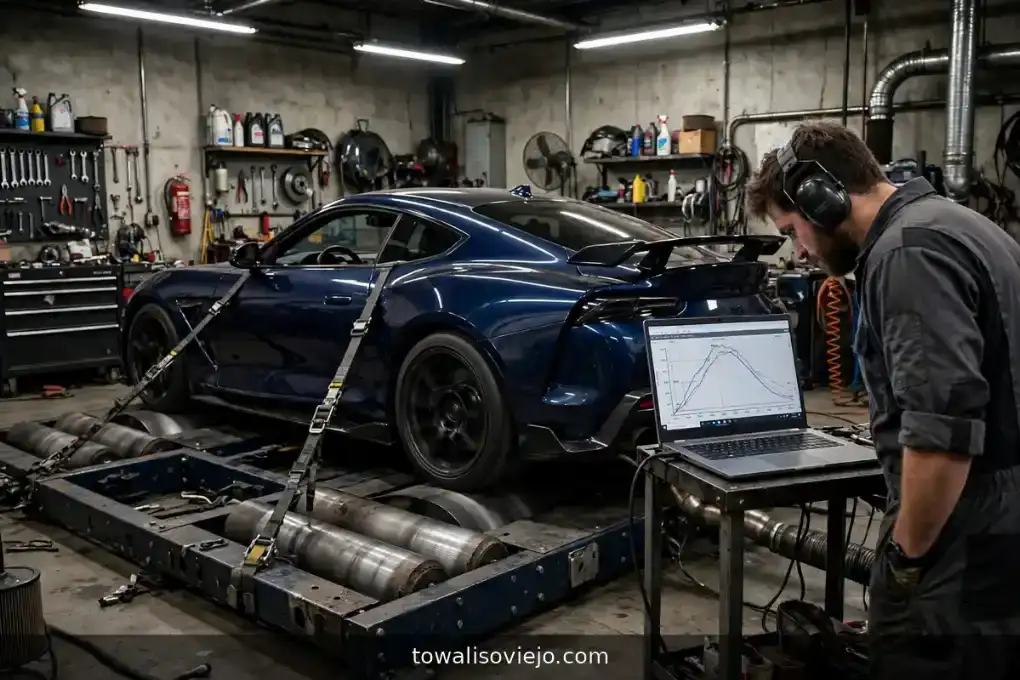
Engineers do not measure horsepower directly. A dynamometer measures torque. A computer then calculates horsepower from torque and engine speed. The test runs through a sweep of rpm. The result is a power curve.
Here is what the curve shows.
- Torque rises as the engine breathes more air.
- Torque peaks at a mid range speed.
- Horsepower keeps rising while rpm climbs.
- Horsepower peaks at a higher speed than torque.
- Both fall off near the redline.
The advertised figure is the peak. An engine makes less at other speeds. Read the whole curve, not just the number. Two engines can both claim 200 horsepower and feel very different. One makes it at 10,000 rpm. The other makes it at 3,000 rpm. The second one feels stronger around town.
What Is the Difference Between Brake Horsepower and Wheel Horsepower?
This question confuses many shoppers. The two numbers measure power at different points.
- Gross horsepower: Measured on a bare engine with few parts attached. It overstates real power.
- Brake horsepower: Measured at the crankshaft with the normal parts fitted.
- Wheel horsepower: Measured at the drive wheels after the transmission and axles take their share.
Power gets lost on the way to the road. The transmission, driveshaft, differential, and axles all add friction. Mechanics call this drivetrain loss. Rear wheel drive cars lose about 15 percent. Front wheel drive loses a similar amount. All wheel drive often loses 20 percent or more.
Here is an example. A car rated at 300 horsepower at the crank may show about 240 to 270 horsepower at the wheels. The car is not weak. The test just measures a different place.
Rating standards also differ. SAE, DIN, and ECE use different test rules. Compare numbers only when the same method made them.
How Much Horsepower Does an Average Car Have?
It depends on the car and the year. Many modern family sedans make roughly 150 to 250 horsepower. Small crossovers sit near the low end. Trucks and performance cars sit far higher. Check the specs on your own car, because trims differ.
More horsepower is not always better. It costs more to buy and to fuel. Lower horsepower often means better fuel economy and gentler acceleration. Higher horsepower and torque give quicker acceleration and better towing.
Use your life as the guide.
- Daily commuter: Pick modest power and good mileage.
- Highway driver: Make sure the car merges well on Interstate 95 or Interstate 10.
- Tower or hauler: Pick strong torque and adequate horsepower.
- Weekend fun: Pick as much as you can afford and use safely.
Does More Horsepower Mean a Faster Car?
Not always. Weight matters just as much. A light car with moderate power can beat a heavy car with big power. Engineers call this the power to weight ratio. It predicts acceleration better than horsepower alone.
Gearing, tires, and traction also matter. A powerful car on bad tires spins and goes nowhere. Cold, icy roads in Chicago or Minnesota prove that fast. Good tires turn power into motion.
Drag matters at high speed. Air pushes harder as you go faster. Horsepower governs how well the car fights that push. That is why top speed needs far more power than cruising.
Does More Horsepower Hurt Gas Mileage?
Often yes, but not always. A bigger engine burns more fuel to make more power. Lower horsepower usually means better fuel economy. Drivers who want savings often choose smaller engines.
Your right foot matters more than the badge. Hard acceleration burns fuel in any car. A turbocharged small engine can sip fuel on the highway and still pass quickly. Weight, tires, and speed also change the result.
Check tire pressure each month with a gauge. Low tires waste fuel and cost you power. Keep the air filter clean. Use the oil grade in your manual. Small habits protect both mileage and horsepower.
Why Do Electric Cars Use Kilowatts Instead of Horsepower?
Most electric car makers list power in kilowatts, and many also list horsepower. The two units measure the same thing. One kilowatt equals about 1.34 horsepower. One horsepower equals about 746 watts.
Some countries use metric horsepower, called PS. It is slightly smaller than the imperial number. A spec sheet in another market may look different even for the same car. Always check the unit.
Electric motors deliver torque right away. That makes many electric cars feel quick off the line. Heat and cold affect battery output, so winter range and power can drop in Minnesota. The idea behind the number stays the same. It tells you how fast the car does work.
Does Heat or Altitude Change Horsepower?
Yes. An engine needs air to burn fuel. Thin or hot air holds less oxygen. The engine makes less power. Many cars feel slower on a hot afternoon in Phoenix or Las Vegas. High mountain roads also steal power.
Modern engines adjust fuel and timing to protect themselves. Turbocharged engines hold power better at altitude. They push more air into the cylinders. A cool, dense morning gives the best results.
Other problems rob power too. A dirty air filter, weak spark plugs, or a clogged fuel filter all lower output. A worn engine loses compression. If your car feels sluggish, test those basics first. A basic compression gauge and a scan tool find many causes.
Can I Add Horsepower to My Car?
You can, but plan with care. Common upgrades include a cold air intake, an exhaust, and a software tune. Turbochargers and superchargers add the most power. They also raise stress and cost.
Follow these rules.
- Start with maintenance. Fresh plugs, filters, and fluids restore lost power.
- Check your warranty before you modify anything.
- Match the parts. A big turbo needs bigger fuel parts and stronger brakes.
- Use a wheel horsepower dyno to see real gains.
- Check local emissions laws before you buy parts.
Be honest about the goal. More power can wear out the clutch, transmission, and tires. Many drivers get more fun from better tires and brakes. Stopping power matters as much as going power. NHTSA reminds drivers that speed raises crash risk.
Tight city driving in Manhattan or Atlanta rarely needs big power. Smooth control wins in traffic.
How Do I Find My Car’s Horsepower?
Start with the owner’s manual. The specs page lists engine power and torque. The original window sticker or brochure often lists it too. Many makers also post specs for each trim on their sites.
Check the engine option on your car. A single model can offer two or three engines. Look at the engine size and the badge on the trunk. If you still cannot tell, ask a parts counter to look up your VIN.
Remember that the listed number is a peak at the crank. Your wheels get less. A wheel dyno shows the real figure.
Put the Power Number in Context
Now you know what is horsepower and why it matters. It measures how quickly an engine does work. Torque launches the car. Horsepower keeps it moving. Wheel numbers are always lower than crank numbers.
Look at the whole picture when you shop. Weigh power, torque, weight, gearing, and tires. Test drive the car on roads you use. When in doubt, ask a certified technician to explain the numbers on your car.
What is horsepower in simple terms?
Horsepower measures how fast an engine does work. One horsepower equals 550 pounds lifted one foot in one second, so it is the speed of work, not just strength.
What is the difference between horsepower and torque?
Torque is the twisting force that gets a car moving from a stop, while horsepower is how quickly that force does work. They are linked by the formula horsepower equals torque times engine speed, divided by 5,252.
Why is wheel horsepower lower than the advertised number?
Power is lost through the transmission, driveshaft, differential, and axles. Rear and front wheel drive cars lose about 15 percent, all wheel drive often loses 20 percent or more, so a car rated at 300 horsepower at the crank may show about 240 to 270 at the wheels.
How much horsepower does an average car have?
Many modern family sedans make roughly 150 to 250 horsepower. More is not always better, since it costs more to buy and to fuel, while lower horsepower often means better fuel economy.
Can I add horsepower to my car?
Yes, with a cold air intake, exhaust, software tune, turbocharger, or supercharger, but start with maintenance, check your warranty and local emissions laws, and match the parts to the rest of the car.