Ram 1500 Towing Capacity: A Mechanic’s Plain Guide
Ram 1500 towing capacity sounds simple until you hook up a real trailer. I have spent over ten years working on half ton trucks. Most towing trouble starts with a bad number, not a bad truck. This guide gives you the real figures, the limits that matter, and the checks I run before every tow. It covers engines, payload, hitches, hills, heat, and cold. Read it before you buy a trailer.
What Is the Ram 1500 Towing Capacity?
A 2026 Ram 1500 can tow up to 11,610 pounds when properly equipped. Most trucks tow less. The exact number depends on engine, axle ratio, cab, bed, and tow package. Payload and tongue weight often limit you first. Check the door jamb stickers for your own limits.
Ram also lists payload up to 2,360 pounds on the 2026 truck. Those are best case numbers. A base V6 truck tows roughly 8,000 pounds. Your truck likely lands between those two figures.
Ram builds these ratings around a test standard called SAE J2807. SAE International wrote it so every truck maker uses the same yardstick. The big test is the Davis Dam climb on Arizona Route 68. A single rear wheel pickup must hold at least 40 mph for about 11 miles. The test starts at 100 degrees with the air conditioning on full.
The test also assumes a light cab. It counts a driver and one passenger at 150 pounds each. It assumes about 10 percent of the trailer weight sits on the hitch. Your family, cooler, and dog change that math fast. Treat the brochure number as a ceiling. Your truck’s labels give the number that counts.
Towing Terms Every Driver Should Know
Five terms show up on every label. Learn them once and the numbers make sense.
Curb weight is the empty truck with fluids. Payload is what the truck can carry in the cab, the bed, and on the hitch. Gross vehicle weight rating, or GVWR, is the most the loaded truck may weigh. Gross axle weight rating, or GAWR, is the limit for each axle. Gross combined weight rating, or GCWR, is the limit for the truck and trailer together.
On a half ton, the rear axle limit often arrives early when the trailer is heavy. Tongue weight is the downward push of the trailer on the hitch ball. It counts as payload, so it eats into your limit fast.
Which Ram 1500 Engine Tows the Most?
Ram offers a few engine choices in recent years. The 3.6 liter V6 with eTorque sits at the low end. The 5.7 liter HEMI V8 returned for 2026 after a one year break. The 3.0 liter Hurricane twin turbo inline six sits at the top.
The standard output Hurricane posts the best rating, up to 11,610 pounds. The HEMI follows near 11,300 pounds. The high output Hurricane makes more power, yet it tows less. On 2025 trucks, that version carried a rating near 9,920 pounds.
Rear axle ratio matters as much as the engine. Dealer guides often list the 3.92 ratio as the best for pulling. Cab style, bed length, and drivetrain move the number too. Four wheel drive adds weight, so it usually lowers the rating. A two wheel drive crew cab with the short bed often reaches the top figure.
One published 2026 chart lists a combined weight rating near 17,000 pounds for Hurricane trucks. It lists 15,850 pounds for HEMI trucks. That combined rating covers the truck, the trailer, and everything loaded in both.
Turbo engines also hold power better in thin air than a naturally aspirated V8. That helps on Interstate 70 in Colorado.
Why Payload Usually Limits You First
Most half ton owners hit their payload limit before they hit the tow rating. Tongue weight should run 10 to 15 percent of the loaded trailer weight. That weight rides on your truck, not behind it.
Here is a real example. Say your sticker lists 1,750 pounds of payload. Four people weigh 600 pounds. Gear adds 150 pounds. The hitch adds 75 pounds. That leaves 925 pounds for tongue weight. At 12 percent, you can pull a trailer near 7,700 pounds loaded.
That figure sits far below the brochure number. It is the number that keeps you safe.
In my shop, I see the same mistake each summer. Owners trust the tow rating and ignore the payload sticker. Then the rear tires, springs, and hitch carry more than the truck allows.
Check the hitch receiver label too. It lists its own weight limits. The lowest rating in the chain wins.
Can a Ram 1500 Tow a Travel Trailer?
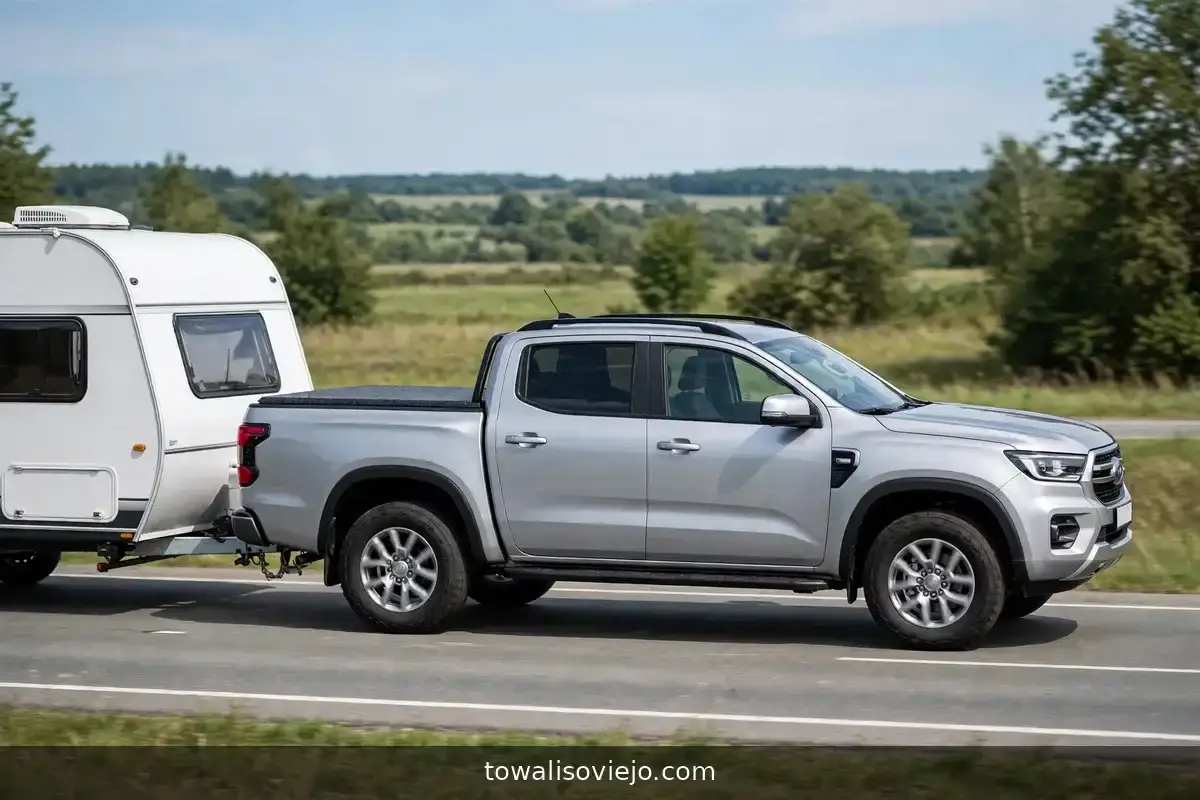
Yes, within limits. Many owners report that trailers near 7,000 to 8,000 pounds loaded feel comfortable. A 30 foot travel trailer can reach 7,000 pounds loaded. That puts it near the sweet spot.
Use the trailer’s gross weight rating, not the dry weight. Dry weight leaves out water, propane, batteries, and your gear. Add those, and the trailer gains hundreds of pounds fast.
Many experienced owners stay near 75 to 80 percent of the rating. That margin helps on windy stretches of Interstate 80 in Wyoming. Tall trailers act like sails there. A truck near its limit has no room to correct sway. Wind, grades, and a tall front profile all raise the load on the engine. Plan for a slower pace and extra fuel stops.
Turn on tow haul mode before you leave. It holds gears longer and adds engine braking on downhills. Use a Class IV hitch for heavy trailers.
Why Does My Ram 1500 Sag When Towing?
Coil springs in the rear give the Ram a soft ride. They also squat under tongue weight. A little squat is normal. A lot of squat points to a heavy tongue or a poor setup.
First, weigh the tongue. Do not guess. A tongue heavy trailer pushes the rear down and lifts weight off the front wheels. That cuts steering and braking.
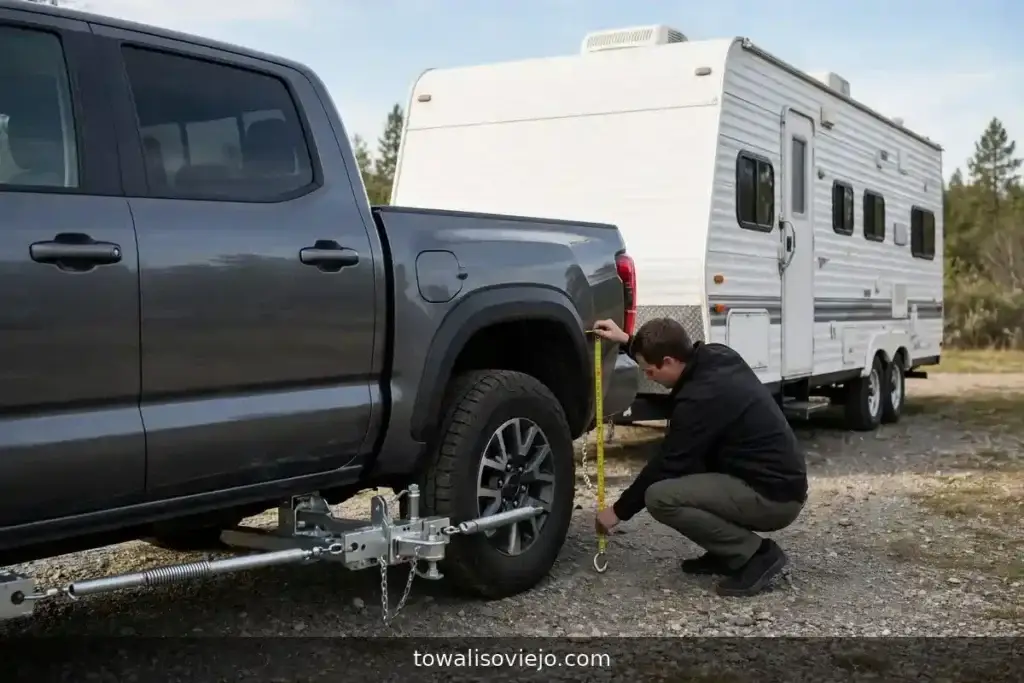
Next, fit a weight distribution hitch. Installers recommend one when the trailer weighs more than half the truck. Pick a hitch whose tongue weight range puts your number near the middle.
Then set it up with a tape measure. Measure fender height at all four corners. Do it empty, then hitched without the bars, then with the bars tight. The front should return close to its empty height.
Do not overtighten the spring bars. Too much tension makes the rear end feel soft and unstable. Skip air bags if you run a weight distribution hitch. The two systems can work against each other.
What the Tow Package Adds
A factory tow package adds a Class IV hitch, trailer wiring, and cooling upgrades. Trucks without it can still pull light loads, but the rating drops.
Ram also offers an integrated trailer brake controller. It sits in the dash and needs no add on box. Power tow mirrors help you see around wide trailers. Trailer sway control uses the stability system to calm a swaying trailer. Reverse guidance and trailer tire monitoring show up on many trims. Check your build sheet to see what your truck has.
How Do I Find My Truck’s Real Tow Rating?
Follow these steps in order.
- Open the driver door. Find the tire and loading label. It lists your payload.
- Find the certification label. It lists GVWR and the axle limits.
- Look up your VIN on the maker’s website or in the owner’s manual. That shows the GCWR and maximum trailer weight.
- Weigh your loaded truck at a public truck scale. Bring the family and the gear.
- Subtract that scale weight from the GCWR. The answer is your trailer limit.
- Compare that answer to your payload math. Use the smaller number.
Online lookups often assume only a driver. Your family trip will not match that.
Mountains, Heat, and Cold: Where Ratings Meet the Road
A test track rating does not cover every highway. Conditions change what the truck can do.
Desert heat in Phoenix or Las Vegas pushes cooling systems hard. Watch the temperature gauge on Interstate 10. Clear bugs and debris from the radiator fins. Pull over if the gauge climbs.
Thin air above 5,000 feet cuts power from naturally aspirated engines. On long downhills, drop a gear and let the engine slow the rig. Riding the brakes cooks them and causes fade.
Freezing mornings in Chicago or Minnesota drop tire pressure about 1 PSI for every 10 degrees. Check tires cold. A healthy battery rests near 12.6 volts. A reading near 12.2 volts means a weak battery that may struggle in the cold.
Interstate 95 traffic punishes short following distances. A loaded rig needs far more room to stop. Tight garages in Manhattan or Atlanta add another problem. Measure your rig height and length before you enter.
Mechanic Checks Before Every Tow
Hitch up on level ground. Run this list each time.
- Battery: Expect 12.4 to 12.6 volts at rest. Expect 13.8 to 14.4 volts with the engine running. Use a multimeter.
- Trailer plug: Probe the seven pin connector with a multimeter. Running lights, brake lights, and turn signals should read near 12 volts when active. A low reading usually means a dirty pin. Clean it with contact cleaner and a small brush.
- Tires: Use a quality gauge. Set truck tires to the door label cold pressure. Set trailer tires to the sidewall maximum cold pressure.
- Lug nuts: Use a torque wrench and the owner’s manual spec. Recheck after the first 50 miles of any new setup.
- Brake controller: Set the gain on a flat road at about 25 mph. The trailer should slow with the truck. It should not push or lock.
- Chains and coupler: Cross the safety chains under the tongue. Latch the coupler and insert the pin. Connect the breakaway cable.
Final Thoughts Before You Hitch Up
Ram 1500 towing capacity starts as a brochure number and ends as a scale number. Learn your payload first. Weigh the truck with your family inside. Stay near 80 percent of the limit.
NHTSA and AAA both tell drivers to respect the weight ratings on the vehicle labels. I agree after years of seeing overloaded rigs. Check your wiring, tires, and hitch every trip. Do that, and your Ram will pull your trailer safely from Interstate 95 to the desert and back.
What is the Ram 1500 towing capacity?
A 2026 Ram 1500 can tow up to 11,610 pounds when properly equipped, but most trucks tow less. Ram also lists payload up to 2,360 pounds on the 2026 truck, and the ratings are built around the SAE J2807 test standard.
Which Ram 1500 engine tows the most?
The standard output Hurricane posts the best rating, up to 11,610 pounds. The HEMI follows near 11,300 pounds, and the high output Hurricane is near 9,920 pounds on 2025 trucks. The 3.6 liter V6 with eTorque sits at the low end, and dealer guides often list the 3.92 ratio as the best for towing.
Why does payload usually limit towing first?
Most half ton owners hit their payload limit before they hit the tow rating. Tongue weight should run 10 to 15 percent of the loaded trailer weight, and that weight, plus passengers and cargo, counts against payload. Check the hitch receiver label too, because the lowest rating in the chain wins.
Can a Ram 1500 tow a travel trailer?
Yes, within limits. Many owners report that trailers near 7,000 to 8,000 pounds loaded feel comfortable. Use the trailer’s gross weight rating, not the dry weight, and many experienced owners stay near 75 to 80 percent of the rating. Turn on tow haul mode before you leave.
Why does my Ram 1500 sag when towing?
Coil springs in the rear give the Ram a soft ride, and they also squat under tongue weight. A little squat is normal, but a lot of squat points to a heavy tongue or a poor setup. First weigh the tongue, then fit a weight distribution hitch when the trailer weighs more than half the truck, and set it up with a tape measure at all four corners. Do not overtighten the spring bars.