
Car Battery Maintenance: A Mechanic’s Step by Step Guide for Every Driver
Most dead batteries trace back to neglect, not bad luck. Good car battery maintenance takes about fifteen minutes every few months. I have jump started cars on freezing Minnesota mornings and in Phoenix summer heat. The cause is rarely a mystery. Heat, short trips, loose clamps, and corrosion kill batteries early. This guide shows you what to check, what tools to use, and when to replace the battery.
What Does Car Battery Maintenance Include?
Battery care covers six checks. Clean the terminals and tighten the clamps. Inspect the case and test the voltage with a multimeter. Drive long enough to recharge. Protect the battery from extreme heat and cold. A healthy battery rests near 12.6 volts and reads 13.7 to 14.7 volts while the engine runs.
Each check takes only a few minutes. You need a wire brush, two sockets, safety glasses, gloves, and a digital multimeter. Keep 10 mm and 13 mm sizes on hand. Add a small battery maintainer if your car sits for long stretches. These tools cost less than one tow from Interstate 80 in January.
The battery stores power, but the alternator does the heavy lifting once the engine runs. A weak battery forces the alternator to work harder. That strain wears out both parts. Keep the battery healthy, and the whole charging system lasts longer.
How Long Does a Car Battery Last?
Most car batteries last three to five years. AAA data shows some reach six years in mild climates. Drivers in hot states often replace batteries sooner. Heat evaporates the fluid inside the battery and speeds up internal wear.
Cold weather does a different kind of damage. A cold battery makes less power while a cold engine needs more. At 32 degrees Fahrenheit, a battery loses roughly a third of its starting power. Near zero degrees in Chicago or Minnesota, it loses about half. A weak battery that survived summer often quits on the first hard freeze.
Check the date code on the case. Many batteries carry a sticker or stamp with a month and year. If yours passes the four year mark, test it every season. SAE International sets the test methods that makers use to rate cold cranking amps. Use that rating when you shop for a replacement.
How Often Should I Test My Car Battery?
Test it twice a year. Pick one day in the fall before winter hits. Pick another in late spring before summer road trips on Interstate 10 or Interstate 95. Many auto parts stores run a free load test. A mechanic can do it in minutes.
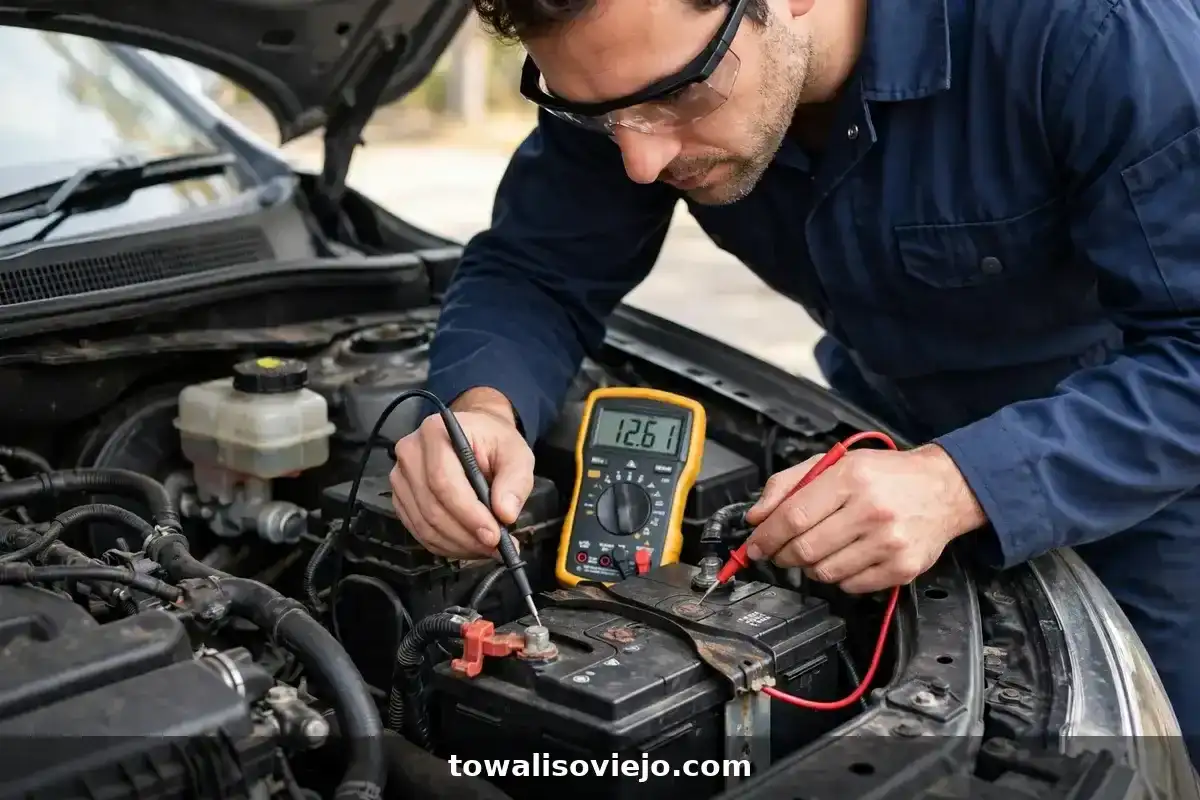
You can also test it at home with a multimeter. Follow these steps.
- Turn the engine off and wait one hour. This removes surface charge.
- Set the multimeter to 20 volts DC.
- Touch the red probe to the positive post and the black probe to the negative post.
- Read the display and compare it to the chart below.
- 12.6 volts or higher: about 100 percent charge
- 12.4 volts: about 75 percent charge
- 12.2 volts: about 50 percent charge
- 12.0 volts: about 25 percent charge
- Below 12.0 volts: discharged
Now start the engine. Voltage should climb to 13.7 to 14.7 volts. A reading under 13 volts points to a weak alternator. A reading over 15 volts means overcharging, which cooks the battery. During cranking, voltage should stay above 9.6 volts. A deeper drop means the battery is tired. A load test adds a heavy draw for fifteen seconds. It exposes weakness that a resting reading hides.
How Do I Clean Battery Corrosion?
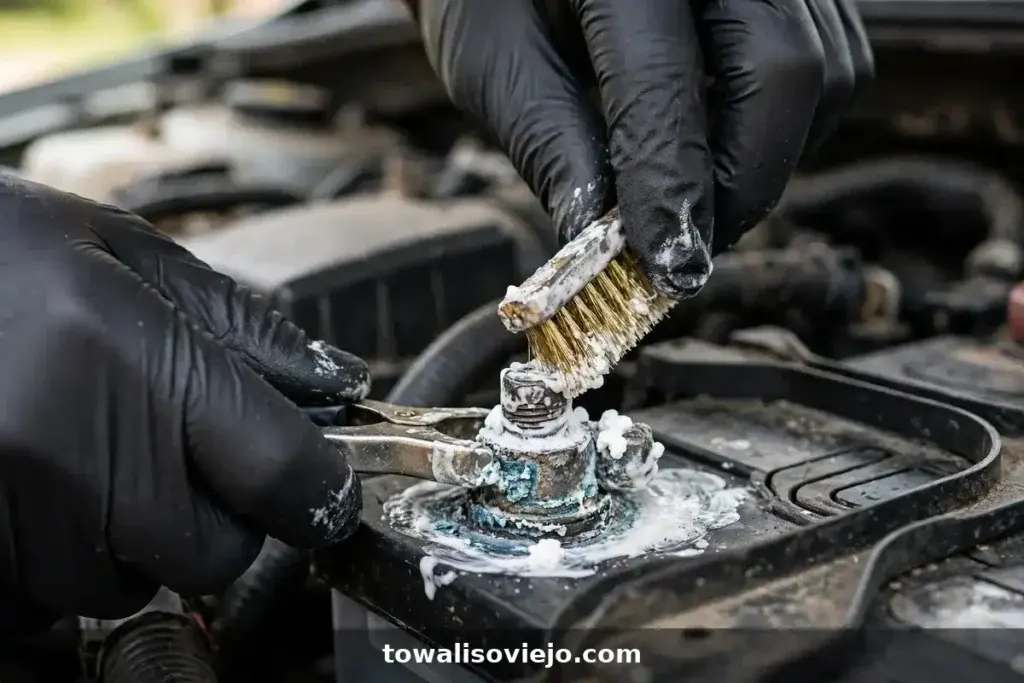
Corrosion looks like white, blue, or green crust on the posts. It blocks current and causes slow starts. Road salt along Interstate 95 and Interstate 80 speeds it up. Sea air does the same on the coasts. Check the posts at every oil change.
Follow these steps for a safe cleaning.
- Wear safety glasses and gloves. Remove rings and watches.
- Turn the engine off. Loosen the negative clamp first and lift it off.
- Remove the positive clamp.
- Mix one tablespoon of baking soda with one cup of water.
- Scrub the posts and clamps with a wire brush until the metal shines.
- Wipe everything dry with a clean rag.
- Reconnect the positive clamp first, then the negative clamp.
- Tighten each clamp to about 5 to 7 foot pounds.
- Spray the clamps with a battery terminal protector.
Never lean over the battery with a flame or spark nearby. A battery vents hydrogen gas, and hydrogen ignites easily. Work in open air, not a closed space. A tight parking garage in Manhattan or Atlanta traps fumes, so open the doors and let air move.
Check the case too, and wipe away dust and grease. A dirty top can leak small amounts of current between the posts. A swollen, cracked, or leaking case means the battery has failed. Replace it right away. Look at the hold down bracket as well. Vibration from a loose battery damages the plates inside.
Does Driving Short Trips Kill a Car Battery?
Yes, it can. Starting the engine uses a big burst of power. The alternator then needs time to put that power back. Trips under fifteen minutes often fail to do it. The battery slowly runs low, and low batteries age fast.
Stop and go traffic in Atlanta or Manhattan makes this worse. Idle speed gives the alternator little output, so the battery never fully recovers. Try to drive at least thirty minutes each week at steady speed. A highway loop works well.
If your car sits for two weeks or longer, use a smart battery maintainer. It watches the charge level and tops it off when needed. This matters most in winter. A discharged battery can freeze solid, and a frozen case cracks. A fully charged battery resists freezing far better.
Also turn off every light and accessory before you shut the engine down. AAA reports that lights left on cause many dead batteries. Unplug phone chargers and dash cameras too if your car lacks a sleep mode.
Why Does My Car Battery Keep Dying?
Start with the simple causes. Lights left on, a door that does not latch, and a failing alternator top the list. Check that the dome light turns off when you close the doors. Look at the glove box and trunk lights as well.
Next, suspect a parasitic drain. This is power that leaks out while the car sits off. Modern cars normally draw 25 to 50 milliamps once their modules go to sleep. A draw above about 50 milliamps can empty a battery in a few days.
Here is how a mechanic finds it.
- Turn everything off and close all doors.
- Disconnect the negative cable.
- Set the multimeter to the 10 amp setting and connect it between the cable and the post.
- Wait 20 to 45 minutes for the modules to sleep.
- Read the current draw.
- Pull one fuse at a time. The reading that drops shows you the faulty circuit.
Aftermarket stereos, alarms, and dash cameras cause many drains. A stuck relay or a bad door switch does too. If the draw looks normal, test the alternator. A battery that dies after a long drive points to a charging problem. A battery that dies after a long sit points to a drain or an old battery.
What Are the Warning Signs of a Failing Battery?
Learn these signs, and you will avoid most roadside calls.
- The engine cranks slowly, even after a recent charge.
- Headlights dim at idle and brighten when you rev the engine.
- Dashboard warning lights appear for no clear reason.
- The battery case looks swollen or misshapen.
- You smell rotten eggs near the battery.
- Resting voltage reads below 12.0 volts.
- The battery is more than four years old.
A rotten egg smell means the battery is leaking or overheating. Stop work and ventilate the area. Do not touch it with bare hands. Call a certified technician if you feel unsure.
How Do Seasons Change Battery Care?
Weather shapes every battery routine. Adjust your habits by the season and by where you live.
In the desert Southwest, heat is the enemy. In Phoenix or Las Vegas, engine bays bake batteries all summer. Park in the shade or a garage. Keep the plastic heat shield in place. If you own a flooded battery with caps, check the fluid level monthly. Top it off with distilled water only. Never use tap water.
In the upper Midwest, cold is the enemy. In Chicago or Minnesota, keep the battery fully charged before winter arrives. Park in a garage when you can. A block heater helps the engine start and eases the load on the battery.
On the East Coast, salt and moisture cause trouble. Rinse the engine bay gently after winter, and keep the terminals coated. On long summer drives along Interstate 10 or Interstate 95, check the voltage before you leave.
When Should I Replace the Battery?
Replace it when it fails a load test, when the case swells, or when it reaches five years. Buy the right type for your car. Cars with start stop systems usually need an AGM battery. A regular flooded battery will wear out fast in those cars.
Match the group size, terminal layout, and cold cranking amps listed in the owner’s manual. Some newer cars also need a scan tool to register the new battery. Skipping that step can cause undercharging. Disconnect the negative cable first and reconnect it last. Keep metal tools away from both posts. Carry the old battery upright, and take it to a retailer for recycling. Many states require it.
Keep Your Battery Ready for Every Mile
Strong car battery maintenance comes down to a few habits. Test twice a year, clean the posts, tighten the clamps, and drive long enough to recharge. Watch for slow starts and dim lights. Use a maintainer when the car sits.
None of this needs a shop. A 10 mm socket, a wire brush, and a multimeter handle most of it. Do the work before the weather turns. Your battery will then start the car on the coldest morning or the hottest afternoon. If something looks wrong, ask a certified technician to check it.
What does car battery maintenance include?
Battery care covers six checks: clean the terminals and tighten the clamps, inspect the case, test the voltage with a multimeter, drive long enough to recharge, and protect the battery from extreme heat and cold. A healthy battery rests near 12.6 volts and reads 13.7 to 14.7 volts while the engine runs.
How long does a car battery last?
Most car batteries last three to five years, and some reach six years in mild climates. Drivers in hot states often replace batteries sooner, since heat evaporates the fluid inside and speeds up internal wear. If yours passes the four year mark, test it every season, and check the date code on the case.
How often should I test my car battery?
Test it twice a year: once in the fall before winter hits, and once in late spring before summer road trips. Many auto parts stores run a free load test. At home with a multimeter, a healthy battery reads 12.6 volts or higher at rest, climbs to 13.7 to 14.7 volts with the engine running, and stays above 9.6 volts during cranking.
How do I clean battery corrosion?
Wear safety glasses and gloves, turn the engine off, and loosen the negative clamp first, then remove the positive clamp. Mix one tablespoon of baking soda with one cup of water, scrub the posts and clamps with a wire brush until the metal shines, wipe everything dry, then reconnect the positive clamp first and the negative clamp last, tightened to about 5 to 7 foot pounds.
When should I replace the battery?
Replace it when it fails a load test, when the case swells, or when it reaches five years. Match the group size, terminal layout, and cold cranking amps listed in the owner’s manual. Cars with start stop systems usually need an AGM battery, and some newer cars need a scan tool to register the new battery.