

When your car smells like rotten eggs, your nose is warning you about sulfur. I have worked as a technician for more than ten years. I hear this complaint every week. Drivers on Interstate 95 report it. Drivers stuck in Phoenix heat report it too. The cause can be cheap or costly. This guide covers the common causes, the tests I run, and the signs that mean you should stop driving.
What Causes a Rotten Egg Smell in a Vehicle?
A rotten egg smell means hydrogen sulfide is reaching your nose. The usual source is a failing catalytic converter. An overcharged battery is the second most common source. Rich fuel mixtures, bad fuel pressure regulators, and old gear oil also cause it. A scan tool and a voltage test find the cause fast.
Gasoline carries trace amounts of sulfur. The EPA Tier 3 rule caps average gasoline sulfur at 10 parts per million. Your engine burns that fuel and makes sulfur gases. A healthy catalytic converter turns hydrogen sulfide into odorless sulfur dioxide. A weak converter lets the hydrogen sulfide pass through. Your nose catches it at tiny amounts. At high levels it dulls your sense of smell, so do not trust your nose alone.
I sort every case into four groups: exhaust, fuel, electrical, and fluids. Start with the exhaust, because that is where most repair bills begin.
How to Pinpoint Where the Smell Starts
Your nose is the first tool. Use it in a smart order.
Outside or Inside the Cabin
Walk around the vehicle with the engine running. A strong smell at the tailpipe points to the converter or the fuel mixture. A cabin smell with a clean tailpipe points to the battery, a leak, or a dead animal. Mildew smells show up only when you run the fan.
Under the Hood or Under the Floor
Open the hood and sniff near the battery. A sharp, acid smell near the terminals means a battery problem. Look under the vehicle next. Wet spots near the axle or transmission point to gear oil. A smell near the middle of the vehicle points to the converter.
Tools I Keep in My Box
You do not need a full shop. These tools cover most cases:
- An OBD II scan tool to read trouble codes
- A digital multimeter to test battery and charging voltage
- A vacuum gauge to check exhaust restriction
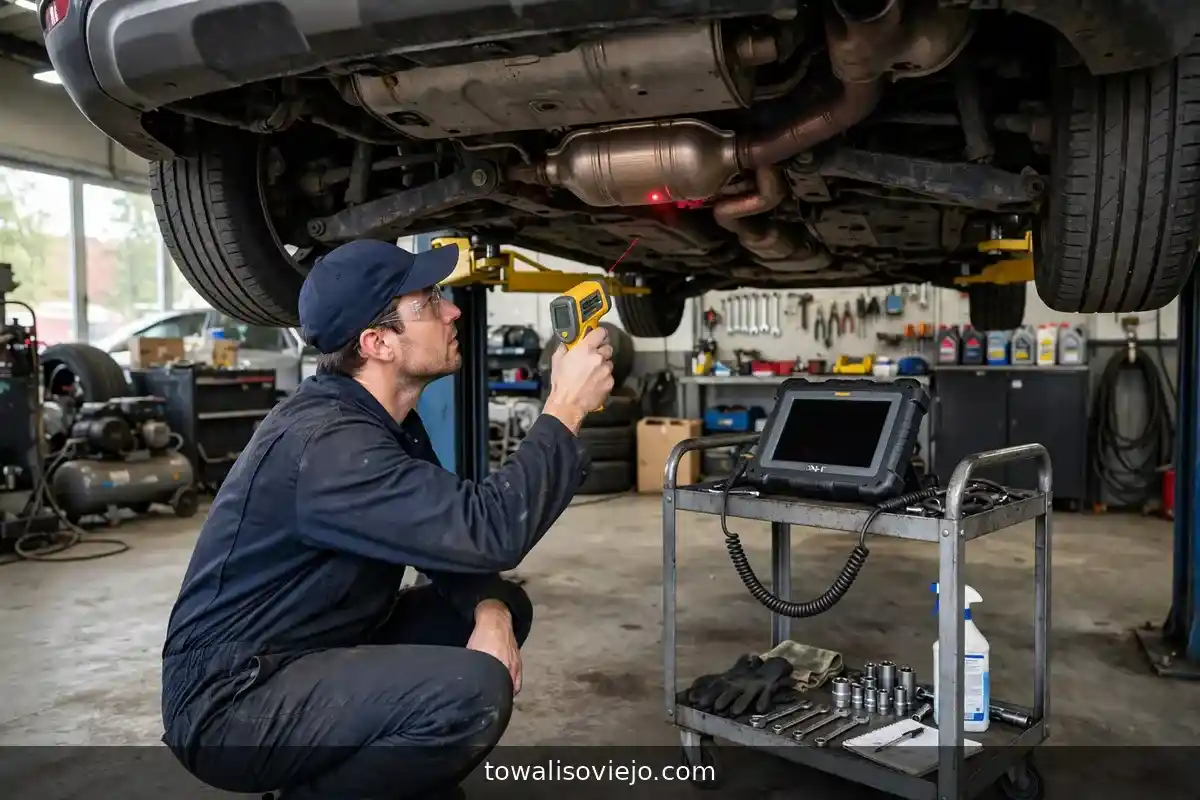
- An infrared thermometer to compare converter temperatures
- A fuel pressure gauge for the fuel rail
The Catalytic Converter Is the Top Suspect
The converter sits under the floor, between the engine and the muffler. It uses heat and precious metals to clean exhaust. Contamination or overheating ruins that coating. Then the sulfur smell starts, often with a check engine light.
What Kills a Converter
Misfires kill converters. Raw fuel enters the exhaust and burns inside the converter. The housing can glow above 1,000 degrees Fahrenheit. A rich mixture does the same slow damage. Burning oil from worn engine seals coats the core with ash. Coolant leaks do the same. A clogged converter also chokes the engine, so you lose power on hills.
Heat brings a fire risk too. Never park a hot vehicle over dry grass in the Arizona desert. A hot converter can ignite brush.
Oxygen Sensors Tell the Story
Two oxygen sensors watch the converter. The upstream sensor switches fast. The downstream sensor should stay steady. Watch the live data on your scan tool. If both sensors switch alike, the converter is not storing oxygen. That pattern, plus a P0420 code, usually means a worn converter.
Tests I Run at the Shop
These four checks confirm a bad converter before you buy one.
- Scan for codes. A P0420 code means catalyst efficiency is low.
- Check temperature. After a full warm up, point an infrared thermometer at the inlet and outlet. The outlet should run at least 100 degrees hotter than the inlet.
- Test vacuum. Connect a gauge at idle. A healthy engine holds a steady 17 to 21 inches of mercury. If the reading drops as you hold 2500 rpm, the exhaust has a restriction.
- Measure back pressure. Thread a gauge into the upstream oxygen sensor port. Idle should read under 1.5 psi. At 2500 rpm it should stay under 3 psi.
Warranty and Break In
Check your warranty before you pay. The federal emissions warranty covers the converter for 8 years or 80,000 miles on most vehicles. Read your warranty booklet or ask the dealer.
A brand new converter may smell for a short time. The odor should fade as it burns off stored sulfur. If it lingers, return to the installer.
Fuel System Problems That Feed the Smell
Fuel trouble often hides behind a bad converter. Fix the fuel problem first, or the new converter dies too.
Rich Fuel Mixtures
A rich mixture means too much fuel for the air. A leaking fuel pressure regulator causes it. So does a dirty injector or a weak oxygen sensor. You may also notice poor mileage, black exhaust smoke, and a gas odor. Hook a fuel pressure gauge to the rail. Many port injected engines run 40 to 60 psi. Check your service manual for the exact spec.
Clogged Fuel Filter
A clogged filter strains the pump and hurts fuel delivery. Shops often list it as a smell cause. I check it when the converter tests good. Many newer vehicles hide the filter inside the tank. Ask a shop about the service interval for yours.
Can a Bad Battery Cause a Rotten Egg Smell?
Yes. Lead acid batteries hold sulfuric acid and water. A failing or overcharged battery boils that mix. The gas it releases smells like rotten eggs. The smell is strongest when you open the hood. Check for a swollen case, wet terminals, or white crust.
A multimeter settles the question in two minutes. Test the battery with the engine off. A healthy battery reads 12.4 to 12.6 volts at rest. Start the engine and test again. A healthy charging system reads 13.7 to 14.7 volts. A reading above 14.8 volts means the alternator regulator is overcharging the battery.
Heat makes this worse. Summer in Las Vegas can cut battery life to two or three years. AAA reports that battery trouble ranks among the top reasons drivers call for roadside help.
Handle a smelly battery with care. Battery gas is flammable. Wear gloves and eye protection. Keep sparks and flames away. Disconnect the negative cable first. Never lean over a hissing or smoking battery.
Why Does the Smell Show Up Right After I Start the Engine?
A cold engine runs rich for the first minute. The converter has not reached working temperature yet. Cold winter mornings in Chicago or Minnesota make this worse. A brief smell that fades quickly can be normal.
A repeat smell that lasts longer points to a problem. A bad coolant temperature sensor can keep the mix rich. An exhaust leak near the manifold can also send fumes into the cabin. Listen for a ticking sound that fades as the metal warms. Never run your hand along a hot pipe.
Why Does the Smell Get Worse When I Accelerate?
Hard acceleration pushes more exhaust through the converter. The core gets hotter and burns off stored sulfur. A merge onto Interstate 10 can trigger it. So can a long climb on Interstate 80 with a trailer. A healthy converter handles the load. A weak one lets the smell through.
Pay attention to the check engine light. A steady light means a stored fault. A flashing light means an active misfire. Slow down and stop soon. Misfires can melt a converter quickly.
Other Causes You Can Check at Home
Gear Oil and Differential Lube
Gear oil carries sulfur based additives. A leak onto a hot exhaust smells like rotten eggs. This affects manual transmissions, transfer cases, and differentials. SAE International sets the viscosity grades printed on gear oil labels, such as 75W 90. Match the grade in your manual. Look for wet spots on the axle housing and drips under the vehicle.
Food, Rodents, and Moisture
Check for real rotten eggs first. Forgotten groceries and fast food leftovers can rot in a trunk. A mouse can also die in a vent or engine bay. Its body gives off sulfur gases as it decays. Look under seats, in the trunk, and near the cabin air filter. Spilled milk in carpet does the same.
Can My AC or Heater Smell Like Rotten Eggs?
Sometimes, yes. Mildew grows on the evaporator when the system stays damp. Humid cities like Atlanta see this often. The smell shows up when you switch on the fan. It often smells like a damp sock, but some drivers call it sulfur.
Replace the cabin air filter every 15,000 miles or once a year. Before you park, turn the AC off and run the fan on high for two minutes. That dries the evaporator. A foam cleaner made for evaporators can kill the growth.
Is It Safe to Drive When Your Car Smells Like Rotten Eggs?
It depends on the source. A faint smell on a cold start gives you time to book a repair. A strong smell inside the cabin does not. Open the windows and pull over.
Stop driving right away in these cases:
- The battery is smoking, hissing, or swollen
- The check engine light flashes
- You smell raw fuel along with the sulfur
- You feel dizzy, sleepy, or sick
- The engine loses power or runs hot
Hydrogen sulfide can irritate your eyes and throat. Carbon monoxide has no smell at all. An exhaust leak under the cabin can fill it with that gas. NHTSA treats fuel leaks and exhaust leaks as safety hazards. Do not take the risk.
What Repairs Usually Cost
Costs vary by vehicle, state, and labor rate. A new battery often costs 120 to 300 dollars. A fuel pressure regulator repair often runs 150 to 400 dollars. A charging system repair often runs 300 to 800 dollars. A converter replacement often runs 1,000 to 2,500 dollars or more. States with strict emissions rules, such as California, often charge more. Get a written quote. Ask the shop to show you the test results.
Fix the Source and Keep the Smell Away
If your car smells like rotten eggs again, start with the simple checks. Look for food, rodents, and wet spots. Test the battery and charging voltage. Scan for codes. Then test the converter. Do not replace parts by guessing.
Prevent a repeat with a few habits:
- Test your battery each fall, before the first freeze
- Fix a check engine light within a week
- Follow the fuel filter and gear oil intervals in your manual
- Fill up at busy stations with fresh fuel
- Check your engine bay for rodent nests each season
A rotten egg smell is your car asking for help. Listen early, and the repair stays small.
What causes a rotten egg smell in a car?
A rotten egg smell means hydrogen sulfide is reaching your nose. The usual source is a failing catalytic converter. An overcharged battery is the second most common source. Rich fuel mixtures, bad fuel pressure regulators, and old gear oil also cause it.
Can a bad battery cause a rotten egg smell?
Yes. Lead acid batteries hold sulfuric acid and water, and a failing or overcharged battery boils that mix. The gas it releases smells like rotten eggs. Test the battery at rest — a healthy battery reads 12.4 to 12.6 volts — and check the charging voltage with the engine running.
Why does the smell show up right after I start the engine?
A cold engine runs rich for the first minute and the converter has not reached working temperature yet. A brief smell that fades quickly can be normal, but a repeat smell that lasts longer points to a problem.
Is it safe to drive when your car smells like rotten eggs?
A faint smell on a cold start gives you time to book a repair, but a strong smell inside the cabin does not. Stop driving right away if the battery is smoking, hissing, or swollen, the check engine light flashes, you smell raw fuel, or you feel dizzy, sleepy, or sick.
How much does it cost to fix a rotten egg smell?
A new battery often costs 120 to 300 dollars, a fuel pressure regulator repair 150 to 400 dollars, a charging system repair 300 to 800 dollars, and a converter replacement 1,000 to 2,500 dollars or more. Get a written quote and ask the shop to show you the test results.