

How to Jump a Car Battery Safely: The Complete Step by Step Guide
Turning your ignition key and hearing a dead click ruins your schedule fast. You might sit in a snowy commuter lot outside Chicago during a freezing January morning. Maybe you parked at a busy shopping plaza along Interstate 95 and left your headlights on. A drained 12 volt battery strands thousands of American motorists every single day.
You do not need to wait two hours for a pricey roadside service truck. Learning how to jump a car battery the right way gets your vehicle running in ten minutes. Proper cable placement also guards your expensive onboard computer modules against sudden voltage spikes. Many well meaning drivers hook up cheap cables backward and melt their main engine fuses. This practical field guide shows you the exact sequence professional master mechanics use every day.
Quick Answer: The 6 Step Battery Boost Sequence
To boost a dead car safely, shut both engines off and connect clamps in this exact order:
- Clip one red clamp to the dead battery positive post.
- Clip the other red clamp to the good battery positive post.
- Clip one black clamp to the good battery negative post.
- Clip the final black clamp to bare unpainted metal on the dead car frame.
- Start the working car, wait three minutes, then crank the dead car.
- Remove all four clamps in the exact reverse order without letting them touch.
Safety Checks Before You Touch Any Cables
Never clip jumper cables onto a battery before inspecting the plastic case under your hood. The National Highway Traffic Safety Administration warns that lead acid batteries hold corrosive sulfuric acid. These batteries also vent flammable hydrogen gas when they charge or discharge. One stray spark near a cracked battery case can ignite that vapor right in your face.
Pull your hood release lever and look closely at the battery box with a flashlight. Check for these four physical warning signs before touching the metal posts:
- Swollen or split plastic walls: Extreme desert heat in places like Phoenix or Las Vegas warps old battery cases. Never boost a bloated or cracked battery.
- Frozen battery fluid: Subzero winter nights across Minnesota or Upstate New York can freeze a fully discharged battery solid. Boosting a frozen battery can rupture the plastic case instantly.
- Rotten egg sulfur odors: A sharp sulfur smell means the battery is boiling internally and venting explosive hydrogen gas.
- Heavy white or blue powder: Thick acid corrosion on the lead posts blocks electrical flow and causes dangerous sparks.
Close the hood immediately if you notice any of these four hazards. Walk away and install a fresh replacement battery instead of risking an acid spray.
What You Need for a Safe Battery Boost
Keeping the right roadside gear in your trunk prevents burned fingers and melted wire insulation. Gather these four essential items before flagging down another motorist for help:
- Heavy duty copper jumper cables: Carry 4 gauge or 6 gauge pure copper cables that reach at least 16 feet. Cheap thin wires from a bargain bin overheat quickly and fail to carry enough cold cranking amps.
- Safety glasses and thick work gloves: Nitrile or leather gloves protect your skin from battery acid powder and sharp radiator brackets.
- A wire terminal brush or dry rag: Wiping grease and oxidation off the metal posts gives the copper jaws a solid bite.
- A gas powered donor car: Ask a driver with a standard gas engine and a healthy 12 volt charging system.
Step by Step: How to Jump a Car Battery With Jumper Cables
Tight parking garages in downtown Manhattan and crowded highway rest stops leave very little room for mistakes. Take two minutes to position both vehicles safely before opening the hoods. Follow these six steps in exact chronological order.
Step 1: Park Both Cars Close and Shut Everything Off
Pull the working helper car nose to nose or side by side with your stalled vehicle. Leave at least two feet of open walking space between the front bumpers. Never let the metal bumpers or fenders of the two vehicles touch each other. Touching car bodies can create an accidental ground loop while you handle the live clamps.
Shift automatic transmissions into Park and manual stick shift cars into Neutral. Engage the parking brake firmly on both cars so neither vehicle rolls on sloped pavement. Turn both ignitions completely off and pull the keys out of the dash. Unplug phone cords, turn off the headlights, and shut down the cabin heater or air conditioner. Turning electrical accessories off prevents sudden power surges when the current starts flowing.
Step 2: Locate the Terminals and Hidden Jump Posts
Open both hoods and secure the prop rods. Most older sedans and pickup trucks mount the 12 volt battery right near the front radiator support. However, many modern SUVs and European sedans hide the battery under the back seat or trunk floor. Look near the plastic engine bay fuse box if you cannot see a battery under the hood. Automakers build dedicated metal jump posts right under the hood for safe and easy boosting.
Locate the positive terminal marked with a plus sign under a red plastic flip cap. Locate the negative terminal marked with a minus sign. Flip open the plastic covers and wipe away loose grime with your rag.
Step 3: Connect the Red Clamps to Positive Posts
Unroll your jumper cables flat on the ground so the insulated wires do not tangle. Never let the red and black metal alligator clips touch each other while connected.
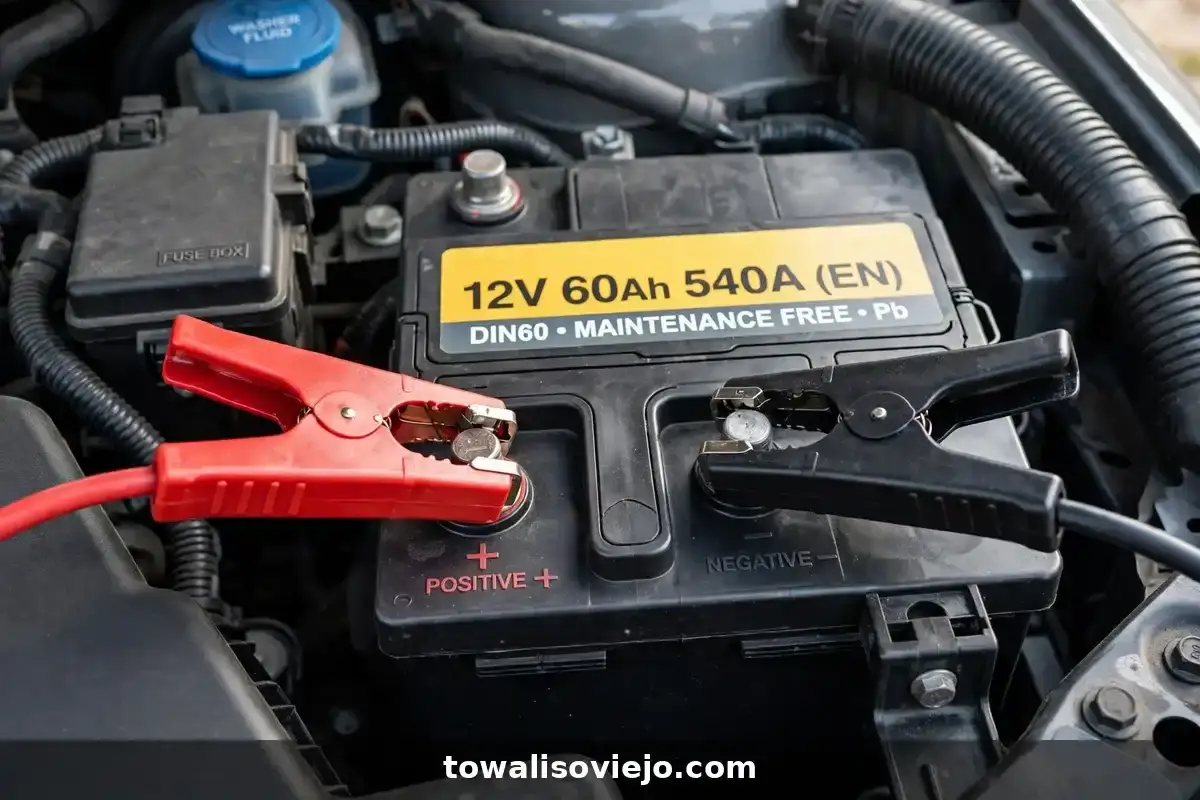
- Squeeze one red clamp and clip it firmly onto the positive post of the dead battery. Twist the clamp slightly so the copper teeth bite through surface dirt into clean lead.
- Walk the other end of the red cable over to the working helper car.
- Clip that second red clamp tightly onto the positive post of the good battery.
Step 4: Connect the Black Clamps to Negative and Bare Metal
Now you will finish the electrical circuit using the black negative cable. Follow this step carefully to keep sparks far away from the battery vents.
- Clip one black clamp onto the negative post of the working helper battery.
- Walk the final black clamp back over to your stalled vehicle.
- Do not clip this final black jaw onto the dead battery negative post.
- Clamp it onto a clean, unpainted metal bolt on the engine block or strut tower. Pick a thick metal bracket at least 18 inches away from the battery box and fuel lines.
Verify that all four cables hang clear of spinning alternator belts and cooling fans.
Step 5: Start the Helper Car and Crank Your Engine
Get inside the working helper car and start its engine. Let the helper vehicle idle smoothly for three to five minutes. You do not need to stomp the gas pedal or rev the engine hard. SAE International automotive electrical standards confirm that a steady idle charges a drained battery safely.
Walk over to your stalled vehicle and turn the ignition key or push the start button. If a small parasitic draw like a glove box light drained the battery, the engine should fire right up. Turn the key off and let the helper car idle for five more minutes if the engine still cranks slowly.
Step 6: Disconnect the Clamps in Exact Reverse Order
Leave both vehicles idling together for two minutes once your engine starts running smoothly. Remove the four clamps in the exact reverse order to prevent electrical arcs:
- Unclip the black clamp from the bare unpainted metal bolt on your jumped car.
- Unclip the other black clamp from the working battery negative post.
- Unclip the red clamp from the working battery positive post.
- Unclip the final red clamp from your jumped car positive post.
Lay each clamp down flat on the pavement as you work so the metal jaws never touch. Coil your cables neatly, close both hoods, and thank the driver who helped you.
Why Do You Ground the Last Black Cable to Bare Metal Instead of the Negative Post?
Motorists on automotive mechanic forums ask this question more than any other. Plenty of drivers clip black to black directly on both batteries without seeing a problem. Still, master technicians and factory owner manuals always instruct you to ground the final clamp to bare chassis metal.
Connecting the fourth clamp completes a live electrical circuit and almost always throws a small spark. At that exact moment, the dead battery absorbs heavy current and vents flammable hydrogen gas through its caps. Grounding the last black clamp to an unpainted engine bolt moves that spark safely away from the battery. It also gives cranking amperage a short, direct path through the steel frame right to the starter motor.
Boosting a Dead Battery Alone With a Portable Lithium Jump Box
Your battery will sometimes die where no other vehicles can pull up next to your hood. You might return to an empty national park trailhead in Colorado after sunset. You might also park nose first inside a cramped airport parking garage near Atlanta. Carrying a charged lithium jump starter pack in your glove box solves this problem without needing a second car.
Follow these steps to use a portable booster pack safely:
- Confirm the booster pack is switched off: Check the digital screen or LED lights to make sure the pack holds at least 50 percent charge.
- Attach the red positive clamp: Clip the red jaw onto the dead battery positive post or remote under hood jump pin.
- Attach the black negative clamp: Clip the black jaw onto a clean, unpainted metal bolt on the engine block or frame.
- Turn the booster box on: Press the main power button on the jump box and wait for the solid green ready light.
- Start your vehicle: Sit in the driver seat and crank the engine.
- Power down and disconnect: Turn the jump box power switch off within 30 seconds of the engine starting. Unclip the black clamp first, then remove the red clamp.
Can You Jump a Dead Battery Using an Electric Vehicle or Hybrid?
American highways from Interstate 5 in California to the Florida Turnpike are packed with electric cars and hybrids. If a friendly driver in an electric vehicle offers to boost your gas pickup or sedan, politely decline.
You can jump start a dead hybrid using a gas car, but never use an electric vehicle or hybrid as the donor car. Electric vehicles do not have belt driven alternators under the hood. They carry a small 12 volt battery solely to boot up the dashboard screens and main high voltage relays. A delicate DC to DC converter charges that small battery. Pulling 400 cold cranking amps to turn over a heavy gas V6 or V8 engine overloads and destroys that converter. That single mistake can trigger a repair bill costing thousands of dollars.
What Should I Do If My Car Just Clicks and Still Will Not Start?
Sometimes you follow every rule on how to jump a car battery and the engine still refuses to crank. You turn the key and hear rapid machine gun clicking or one heavy metallic clunk. Use these four mechanic troubleshooting steps to find the culprit:
- Twist the cable jaws for a fresh bite: Paint, grease, or gray oxidation on the posts blocks electrical flow. Wiggle all four clamps so the copper teeth dig into clean metal, then let the helper car charge for five more minutes.
- Check for loose factory battery rings: Grab your car’s own battery cable ends and try to twist them by hand. Starter amperage cannot pass through if the lead factory ring spins loosely on the battery post.
- Tell starter clicks apart from battery clicks: Fast rapid clicking means low voltage is reaching the starter. One loud single thud when you turn the key usually points to a worn starter solenoid or seized starter motor.
- Inspect the battery age date code: Look for a round sticker on the battery top showing the month and year of manufacture. Most lead acid car batteries last only three to five years before an internal cell shorts out completely.
Stop turning the key if the engine will not crank after three tries. Repeated cranking overheats the starter windings and drains the donor car.
Driving After a Boost: How Long Do You Need to Drive to Recharge the Battery?
Do not shut your engine off to grab coffee or run inside your house once the car fires up. A jump start only puts enough surface charge into the battery to spin the starter motor one time. The battery will click and die all over again if you turn the key off after five minutes.
Your alternator needs steady highway RPMs to push amperage back into the lead plates. Let the vehicle idle for five minutes first, then take a 30 minute drive in open traffic. Cruising at steady highway speeds along an open stretch like Interstate 10 or Interstate 80 works best. Keep your air conditioner, rear defroster, heated seats, and stereo turned off during this recharge drive. Sitting in stop and go city traffic with heavy electrical accessories running barely sends any surplus power back to the battery.
Where to Get Your Battery and Alternator Tested for Free
A jump start is only a temporary fix if your battery is past its lifespan. Drive straight to a national auto parts store once you have run the engine for 20 to 30 minutes. Major auto parts retailers across the United States roll a digital load tester out to the parking lot for free.
Ask the technician to run two quick checks while your car sits in the lot:
- A cold cranking amps load test: This test measures whether the internal lead plates can still hold a charge under heavy starter demand.
- An alternator charging voltage test: A healthy alternator should put out between 13.8 and 14.4 volts while the engine is running. If the meter reads below 13 volts, your alternator is failing and needs replacement rather than a new battery.
Will Jumping a Modern Car Fry the Onboard Computer?
Drivers with newer trucks and luxury sedans often worry about ruining their Electronic Control Unit during a boost. A modern vehicle relies on more than 50 sensitive computer modules that run fuel injection, transmission shifting, and radar safety sensors.
Jumping a modern car is completely safe when you obey three core rules. First, never cross the red positive and black negative clamps. Reverse polarity sends electrical current backward through the fuse box and blows the main 100 amp fusible link immediately. Second, never disconnect a battery cable while the engine is running to test the alternator. Old school mechanics used that trick in the 1970s, but pulling a cable off a running modern car creates a massive voltage spike. Third, always connect and remove the cuatro clamps in the exact sequence outlined in this guide. Knowing how to jump a car battery properly protects your vehicle electronics and gets you back on the highway safely.
Why should the last black cable go to bare metal instead of the negative post?
Connecting the final clamp closes a live electrical loop and almost always throws a small spark. At that moment the dead battery is soaking up current and venting flammable hydrogen gas, so grounding the last black clamp to an unpainted engine bolt moves the spark far away from the battery. It also gives cranking power a short, direct path through the chassis to the starter motor.
Can you jump a dead battery using an electric vehicle or hybrid?
Never use an EV or hybrid as the donor vehicle. Electric vehicles have no belt-driven alternator and use only a tiny 12 volt battery to wake up cabin computers, fed by a delicate DC to DC converter that can fry when asked to supply 400 cold cranking amps. You can jump start a dead hybrid using a gas car. That single mistake can trigger a repair bill costing thousands of dollars.
What should I do if my car just clicks and still will not start after a jump?
Twist all four clamps for a clean bite and charge for five more minutes, check that the car’s own battery cable rings are not loose on the posts, and tell the sounds apart: fast rapid clicking means low voltage, while one loud single thud usually points to a worn starter solenoid or seized starter motor. Also check the battery age date code: most lead acid car batteries last only three to five years before an internal cell shorts out. Stop cranking after three failed tries.
How long do you need to drive to recharge the battery after a jump start?
Let the engine idle for five minutes first, then drive for at least 30 minutes in open traffic with the air conditioning, rear defroster, heated seats, and stereo turned off. A jump start only puts enough surface charge in the battery to spin the starter once, and sitting in stop and go traffic barely sends any surplus power back to the battery.
Will jumping a modern car fry the onboard computer?
Jumping a modern car is safe when you follow three strict rules: never cross the positive and negative clamps, since reverse polarity blows the main fusible link instantly; never disconnect a battery cable while the engine is running, since that creates a massive voltage spike; and always connect and remove the four clamps in the exact sequence outlined in the guide.